What to See at Castillo de Colomares: The Sixteen Chapters and Beyond
Planning your visit?Guided slots are limited and fill up fast in summer on the Costa del Sol. Cancellation is free up to 24 hours before — book now, decide later.
Check tour availabilityThe sixteen chapters: a story in stone
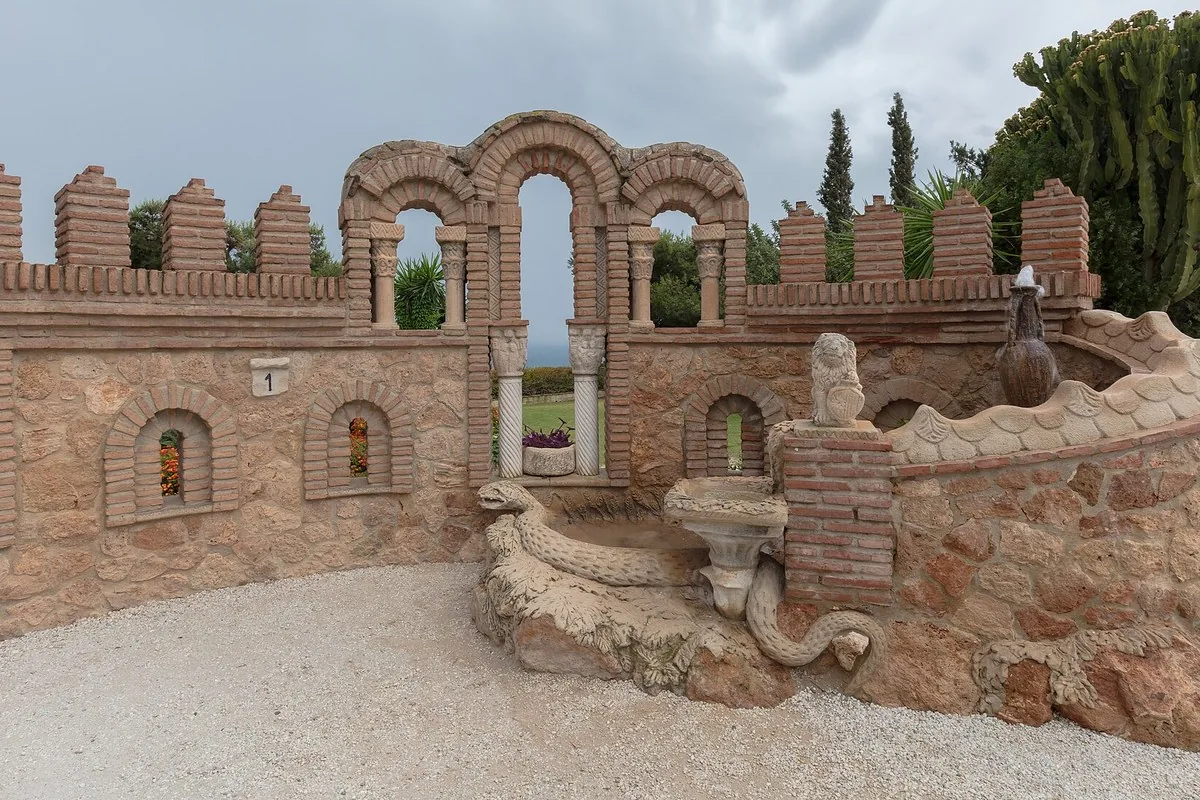
The monument is a narrative. Walking the circuit, you pass through sixteen episodes, each carved into the stone and integrated into the architecture. Chapter 1 has a visible number plaque. The chapters progress through the Columbus story: his early life and preparation, his pitches to the Spanish monarchs, the decision to back him, the voyage itself, landfall, the consequences for Spain and Europe, and his legacy. The chapters are not labeled on site. You see them, photograph them, and unless you know the story already or are taking a guided tour, they remain visual — beautiful and obscure. This is the gap the €9 guided tour fills.
The three ships carved into the walls
Three ships are not freestanding models but architectural features built into the stone. La Niña and La Pinta are visible as stone prows and hull features as you walk the grounds. La Pinta carries a Pegasus (a winged horse), marking Martín Alonso Pinzón, the captain of that vessel. La Santa María is the flagship. Each ship is integrated into the layout so that as you walk, the monument's structure gradually reveals its maritime identity. Most visitors miss this entirely without a guide pointing it out.
The Chinese pagoda
A pagoda represents Columbus's actual goal — sailing west to reach Asia. Columbus wanted to find a shorter sea route to China and India, where the spice trade would make him rich. He did not find it. Instead, he found a continent he was not looking for. The pagoda sits in the complex as a reminder of what he was chasing — and how history pivoted on his failure to find what he sought.
The empty mausoleum
A Gothic rosette mausoleum, ornate and architectural, was built in the hope of one day holding Columbus's remains. The remains never came. Columbus died in 1506 in Valladolid, Spain, and was eventually buried in Seville Cathedral, where they remain. The mausoleum in Colomares stands empty. It is a monument within the monument — a visual statement that some things do not reach completion.
Santa Isabel de Hungría: the smallest church
A consecrated chapel measuring exactly 1.96 m² (about 21 square feet). It is recognised by Guinness World Records (April 1990) as the world's smallest church. It is not decorative or symbolic. It is a working chapel. Weddings are held in it. The space is cramped — you step into it and see that it is real, furnished, and devoted. See the dedicated page on the smallest church for details.
Architectural styles deliberately mixed
Byzantine, Romanesque, Gothic, and Mudéjar architecture are woven throughout. These represent the four periods of Spanish history that produced the conditions for the 1492 voyage. The mix is not accidental; Dr Martín chose it deliberately. Byzantine (empire), Romanesque (feudal expansion), Gothic (the age of cathedrals and kingdoms), Mudéjar (the Islamic-Christian synthesis in medieval Spain) — each period brought Spain closer to the moment when the Catholic Monarchs would back Columbus.
Practical notes on exploration
Stairs and loose cobbles are throughout. The monument is almost entirely exposed, with almost no shade. Walking in July midday is punishing even in the small shaded corners. Early morning or late afternoon is the way to visit. Wheelchair accessibility is not possible — stairs, cobbles, uneven ground. The toilet facilities exist and are frequently criticised. Bring water. There is no café, no shop. See the accessibility page for details.
The visitor journey
Most visitors walk the perimeter circuit, stopping at each chapter, climbing the stairs between levels, passing through the archways, viewing the ships, circling the mausoleum, and stepping into the smallest church. The circuit takes 40 minutes with a guide, 45–60 minutes on your own pace, longer if you photograph everything. After the guided portion, most tours give you free time to linger on any detail that caught your attention.
The genius of the monument is the detail — the placement of symbols, the progression of chapters, the integration of the ships into the walls. It is invisible without explanation. Even with explanation, you will notice new details on a second walk.
Frequently asked questions
What exactly is there to see at Colomares?
Sixteen numbered chapters carved into the stone telling the Columbus story; three ships (La Niña, La Pinta, La Santa María) built into the walls; a Chinese pagoda representing Columbus's goal to reach Asia; a Gothic rosette mausoleum (empty, waiting for Columbus's remains); Santa Isabel de Hungría, the world's smallest church at 1.96 m²; and mixed architectural styles (Byzantine, Romanesque, Gothic, Mudéjar).
What are the sixteen chapters?
Episodes of the Columbus story carved into the stone in sequence, representing his life, his pitch to the monarchs, the voyage, discovery, and legacy. Chapter 1 is marked with a visible plaque. Nothing on site explains what they mean — that is what a guide does.
Can I see the smallest church?
Yes. Santa Isabel de Hungría is 1.96 m² (about 21 square feet), recognised by Guinness World Records as the world's smallest church. It is consecrated, and weddings are held in it. Full details on its dedicated page.
Is the monument really just exterior?
Yes. The monument is built as an exterior-only complex. No interior rooms, no halls, no audio guide, no interpretive panels. You walk the grounds, look at the chapters, climb the stairs, and see the ships and symbols. A guide turns that visual experience into understanding.